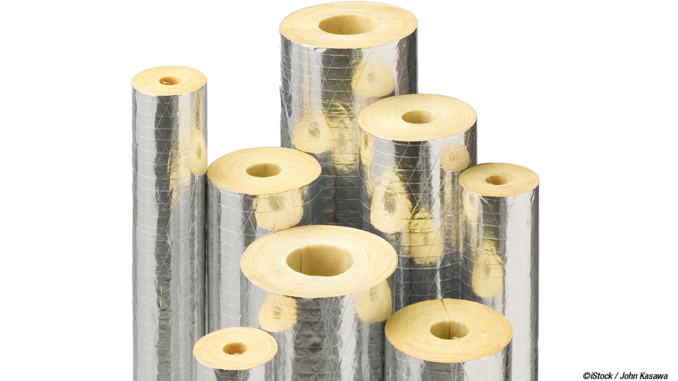
Contractors are feeling the pinch on fibreglass pipe insulation shortages and manufactures are racing to respond
By / Jessica Kirby
Nick Mastromatteo, partner and estimator at Insul Fibre Ltd. in Saskatchewan, has been trying to source fibreglass pipe insulation for the past 18 months, without much luck finding the quantities he needs within the timeframe he is used to. His is not a unique problem.
Across North America, supply chain disruptions, a surge in single-family new construction in the United States, and stricter residential and commercial energy codes have reduced availability to the extent that contractors and distributors are waiting eight weeks or more for materials that used to take a week or two to arrive.
“The problem with this is that we are always the last contractors on site; however, our bid is due at the same time as every other trade,” Mastromatteo says. “For example, we are 92% billed on a project that we submitted a bid for on June 21, 2022. We have seven other projects all like that—all bid before we knew about any material shortages.”
Scheduling delays outside contractors’ control create uncertainty, especially when it comes to bidding and forecasting the workforce.
In an effort to mitigate shortages, manufacturers have put their distributors under allocation based on last year’s sales plus a growth factor, but this can make it difficult to find a source for the size and the quantity required for a specific project.
“It’s also hard to predict which size the distributors will be out of this week,” Mastromatteo says. “Two weeks ago, there was no 1×1-1/2” insulation anywhere in the province. Four weeks ago, it was 3×2. Six weeks ago, it was 3/4 x 1-1/2.”
Fiberglass is typically used on commercial and institutional projects, with most of it being consumed by provincially funded institutional projects, like schools and hospitals.
“The industrial sector typically chooses to use stone wool insulation in place of fibreglass insulation,” Mastromatteo says. “With the new federal government’s focus on housing, we are now seeing an uptick in walk-up condos being built in the province, which will consume a significant chunk of our allocation, further compounding this issue.”
He adds that Saskatchewan is one of the more fortunate regions in the country. “Saskatchewan experienced growth in fibreglass post-pandemic, as the provincial government released several infrastructure projects to help prop up a stagnant economy,” he says. “These projects were well underway prior to the allocation, and Saskatchewan’s baseline is therefore higher than it would have been if Saskatchewan’s growth were delayed by two years.”
On the upside, the shortage has forced project managers at Insul Fibre to proactively forecast material needs four to six weeks in advance rather than a week or two ahead of time.
“That said, it is only so effective considering we are still dealing with the trades and the drywallers still dictate the schedule on some of our projects,” Mastromatteo says.
At five years into the AI data centre boom, contractors have questions about when supply will find equilibrium with the industry’s new demand. Mastromatteo wonders how manufacturers could better support small scale contracting companies whose entire reputation rests on completing projects on schedule.
According to the Fibreglass Pipe Insulation Market Global Outlook for 2024-2033, the fiberglass pipe insulation market is projected to reach a valuation of over $3 billion by the end of this year. This upward trajectory is driven by increasing demand across industries such as oil & gas, power generation, data centres, and HVAC, where energy efficiency and safety standards are paramount.
The fibreglass pipe insulation supply experienced significant volatility between 2019 and 2024. Interruptions and erratic demand, thanks to COVID-19, geopolitical tensions, and high inflation rates, caused a sharp decline in 2020. The market rebounded in 2021 with the easing of restrictions and a surge in construction and industrial activity.
Demand continued with a surge in home improvement efforts and pent-up demand for appliances. The residential market also drew heavy demand as housing construction recovered in many countries, as did the transportation, automotive, and aerospace production sectors.
Looking at volume, consumption of fiberglass insulation worldwide is forecast to grow at 3% over the outlook period to reach 6.4 million metric tons in 2030.
Ginny Gier, national key account manager for Owens Corning, says the company has had limited availability since July 2025. “We are trying to come up with the good science of getting the right materials by pounds to the right people based on projects and prior years’ usage,” she says. “We don’t see coming out of this state this year, but we are adding volume to our capacity every year over year, based on being able to run more efficiently and having orders in well in advance.”
Owens Corning makes fibreglass pipe insulation to order, which means longer lead times are a key factor in achieving adequate supply. The company has been working on a number of solutions to increase efficiency and get more pounds out of its existing plant, and in 2026 announced a new fibreglass insulation line at its Kansas City manufacturing facility. For now, there is no definitive plan for another pipeline.
“We are looking for other ways to help contractors meet their goals,” Gier says, including alternative products. “We have FlexWrap, used for pipes in data centres and other projects with large bore pipes, which can then be metaled or PVCed. We have also partnered with other fabricators to create a product out of our board called V-Groove fibreglass, which alleviates some of those pain-points for contractors who can’t get that preformed fibreglass in the right amount of time or enough of it.”
For contractors, Gier urges, the most important thing they can do is provide a runway. “We need to know what is coming so both distributors and manufacturers can work together for success,” she says. “More than ever, pre-planning is essential so projects can be successful. We can meet contractors’ needs if they give us time.”
Knauf Insulation, Inc. has started to address the shortage with significant investment into its Shelbyville, Indiana, operations, also citing response to evolving customer needs and continuous growth. The investment includes comprehensive upgrades to its existing pipe production, the addition of a new pipe production line, and expanded glass capacity to support both pipe and blowing wool production. These upgrades enhance and modernize the manufacturing processes and increase production capacity.
“The investment in our Shelbyville operations reflects Knauf’s commitment to innovation, sustainability, and meeting the evolving needs of our customers,” said Knauf CEO, Matt Parrish. “By modernizing our production capabilities and expanding capacity, we are not only strengthening our ability to deliver high-quality products but also reinforcing our confidence in the long-term growth of the market and our partnerships with our customers.”
The pipe production line improvements will be made during a scheduled rebuild, and the new blowing wool line is expected to be commissioned by Q2 of 2026.
The company sees the investment as part of a broader strategy to future-proof its operations by integrating advanced technologies and enhancing sustainability.
The Fibreglass Pipe Insulation Market Global Outlook for 2024-2033 says innovation in fiberglass insulation materials is gaining traction as IoT integration and AI in manufacturing processes enables real-time quality monitoring, reducing waste, improving consistency, and lowering production costs.
The report says the supply chain for fiberglass pipe insulation is becoming more resilient, “with major players forging strategic partnerships across raw material sourcing, manufacturing, and distribution channels.” Regulatory shifts—such as stricter fire safety and environmental standards—are prompting companies to innovate and diversify their product portfolios. The report recommends stakeholders focusing on building robust supplier relationships, investing in R&D, and aligning with regulatory trends to maintain a competitive edge in 2026.
“For industry stakeholders entering or expanding in the fiberglass pipe insulation market, a clear go-to-market strategy involves emphasizing sustainability credentials, technological differentiation, and compliance expertise,” says the report. “Additionally, developing capabilities in digital marketing, technical consulting, and after-sales support will help establish a strong market presence and foster long-term customer relationships.” ▪