TIAC’s membership in New Economy Canada will create opportunities for visibility, advocacy, and policy development for members
By Jessica Kirby • Photos courtesy of New Economy Canada
Earlier in 2025, TIAC became a member of New Economy Canada (NEC), a national, non-partisan alliance of business, Indigenous, and labour organizations committed to building Canada’s clean economy.
Its growing membership employs or represents more than 410,000 workers and generates annual revenues of more than $200 billion in new and traditional industrial sectors that are acting now to build resilient and affordable clean energy and technology that grows investment, jobs, and energy security.
Canada’s new, clean economy a win-win
Current members come from a wide range of sectors driving the clean economy, including energy, transport, manufacturing, technology, finance, mining, and construction.
“Above all, New Economy Canada members meet a set of core principles that include being actively involved in building Canada’s clean economy, working across party lines, advancing reconciliation with Indigenous Nations and Peoples, and believing in the power of collective action,” says Faisal Rezwan, director of government affairs, policy and economic analysis for New Economy Canada.
TIAC is a good candidate for NEC membership because its members play a critical—yet often overlooked—role in advancing Canada’s clean economy. By promoting high-performance thermal insulation across sectors, TIAC and its members directly contribute to emissions reductions, energy efficiency, and cost savings—core NEC priorities.
“TIAC’s members are actively operating across Canada, employing Canadian workers and generating economic activity through the manufacture, distribution, and installation of insulation products and systems,” Rezwan says. “With proven commercial solutions that are already scaling, TIAC members demonstrate credible leadership in driving both environmental and economic performance.”
Tristan Bertram, director of industry affairs for TIAC, says the association joined NEC because the organizations are aligned in their mission and values and membership helps TIAC stay plugged into policy developments.
“NEC provides a platform for collaboration between industry and government,” Bertam says. “TIAC saw an opportunity to amplify our advocacy efforts and ensure mechanical insulation is part of the national conversation around climate solutions.”
TIAC contributes to the clean economy in Canada by reducing carbon emissions from both new and existing mechanical systems, providing an immediate solution to accelerate Canada’s carbon reduction goals.
“Our work makes current infrastructure more sustainable—helping safeguard existing industries while more innovative, eco-friendly technologies are developed,” Bertram says. “And as those new solutions emerge, our industry will continue to play a key role in maximizing their performance.”
Advocacy Day in Queens Park
NEC held its second annual Advocacy Day in Toronto this May, giving members the chance to speak with MPs and MLAs about clean economy opportunities. The group has held a similar event in Victoria, British Columbia, and hosts regional events across the country as part of its #GettingThingsBuilt cross-Canada tour. The tour invites local elected officials, business and industrial sector leaders, and supply chain partners to showcase companies that are investing, building, and hiring locally.
“Our goal for these advocacy days and tour stops is to raise awareness of what the clean economy means to people and communities in terms of jobs, support for local small businesses, wages, and quality of life,” Rezwan says. “In doing so, we want to grow public and political support for accelerating investment in the clean economy.”
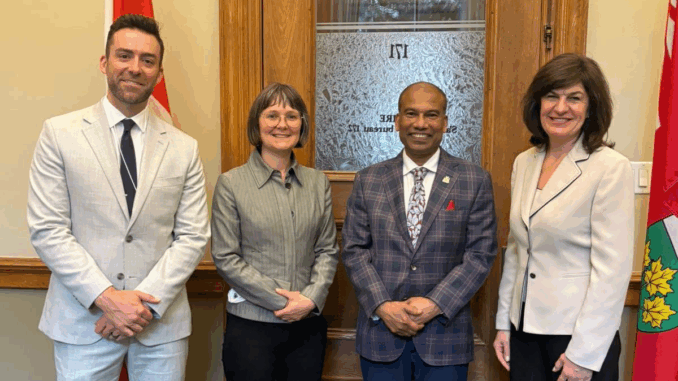
At the May Advocacy Day, NEC members, including TIAC representative Darren Sloane, All Temperature Thermal Insulations Ltd., met at Queen’s Park to meet with Ministers, Associate Ministers, opposition critics, MPPs, and political staffers. NEC members shared priorities for Ontario’s clean economy as well as specific insights on the realities their industry or sector faces.
Sloane, who is also Ontario Contractor Representative on the TIAC board of directors, says it was a great opportunity to represent the mechanical insulation industry.
“It provided a chance to share our story, highlight our impact, and show policymakers how we fit into the new economy,” he says.
NEC members were assigned to teams of three or four individuals, and each group met with a range of officials to discuss NEC’s core issues—things like workforce development, clean energy, and innovation.
“After meetings, we networked with other NEC participants and government officials and had the chance to learn from a cross-section of industries contributing to Ontario’s economy,” Sloane says. “It was fast-paced and humbling but also energizing.”
Workforce challenges—attracting and retaining skilled tradespeople—came up in almost every meeting. Sloane also shared specific examples of mechanical insulation work and how it contributes to energy efficiency and emissions reduction. “Another recurring theme in our conversations was the importance of rebuilding domestic manufacturing capacity,” he says. “There seemed to be genuine interest from government officials in supporting policies that bring back or scale up production here in Ontario, which could be significant for our industry.”
“We also heard directly from elected officials and staffers about their priorities, shared our views and shared ideas on how to collaborate in moving Ontario’s clean economy forward,” Rezwan says.
A voice for the future
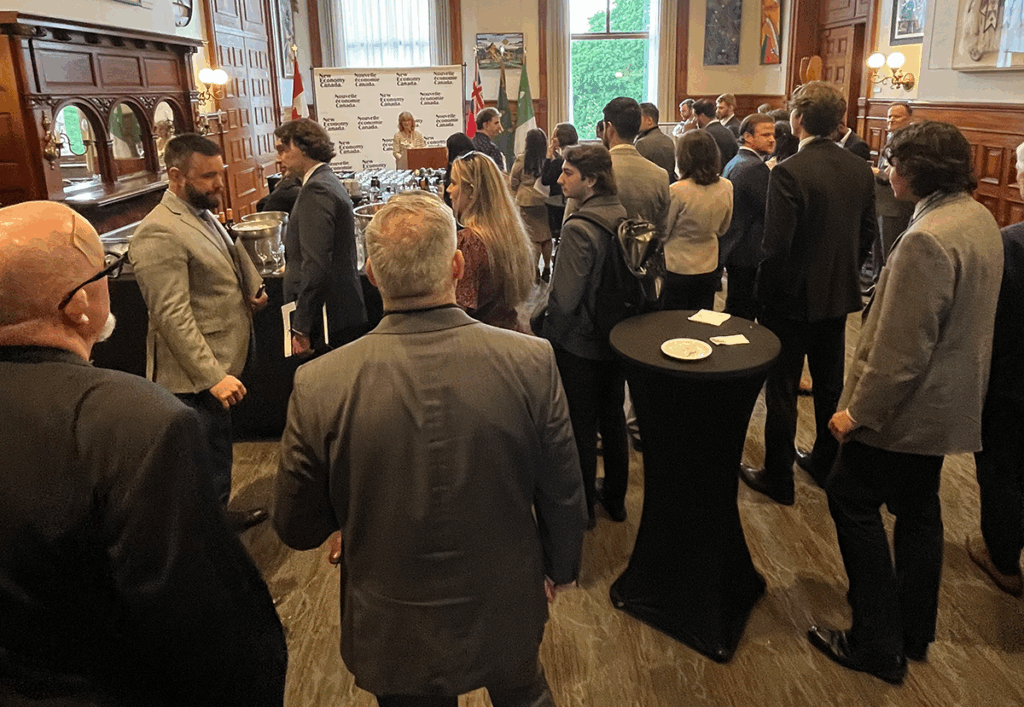
At the end of the day, NEC hosted a reception at Queen’s Park where Hon. Todd McCarthy, Minister of Environment, Conservation & Parks; Rob Cerjanec, MPP, Liberal Critic for Economic Development and Innovation; and Aislinn Clancy MPP, Member Standing Committee on Social Policy, spoke about the importance of the clean economy.
With an abundance of clean electricity, an untapped supply of critical minerals, and the infrastructure to be a hub for EV and battery manufacturing, Ontario has many advantages to grow the clean economy.
“Ontario has made significant investments in the clean economy, but the advantages are dependent on policy and market certainty. Rezwan says. “Tariffs have created a major challenge. We need to support our affected industries, take a long-term view to double down on Ontario’s advantages, and seize the opportunities through the turbulence to set us up for the future.”
NEC is calling on elected officials to remove red tape and create incentives to procure more home-grown, low-carbon building materials and energy efficient buildings. It seeks momentum on skills training, reskilling, and talent attraction to support clean energy projects, infrastructure, and jobs. It also invites engaging First Nations as full partners in clean energy projects and infrastructure by efficiently implementing the expanded $3B Indigenous Opportunities Financing Program.
“We also want government to ensure Bill 5, which amends the Electricity Act and Ontario Energy Board Act to allow bans on procurement from regions and countries, has guardrails to prevent unintended consequence to businesses in Ontario and Canada,” Rezwan adds. “With renewables providing the most cost-effective form of generation, bans without guardrails will drive up costs for ratepayers in Ontario.
Progress for TIAC
The May Advocacy Day opened direct lines of communication between the mechanical insulation industry, alongside NEC, and key decision-makers, which is a major step forward.
“We could see follow-up opportunities for TIAC to participate in consultations or working groups, especially as the province rolls out climate and workforce initiatives,” Sloane says. “There’s real potential for policy shifts that recognize the role our industry plays in reducing energy waste and supporting local jobs.”
Long-term, TIAC’s involvement with New Economy Canada will be working to raise the profile of mechanical insulation as a clean economy solution and ensure the mechanical insulation industry is represented in policy conversations.
“We see this collaboration as an opportunity to increase TIAC’s influence, build new relationships with aligned organizations, and open the door to more coordinated advocacy,” Bertram says.
Sloane encourages TIAC members to read NEC updates, understand the organization’s advocacy priorities, and consider how those intersect with the mechanical insulation industry.
TIAC members can also share stories from the field—real examples of how their work supports infrastructure resilience, sustainability, and economic growth.
“Those stories make a difference,” Sloane says. “For members interested in advocacy, there’s room at the table. Whether it’s joining TIAC’s newly formed Government Relations Committee or attending events like NEC’s Advocacy Day, our collective voice is much stronger when more of us are involved.”
Help us spread the word about the clean economy. Follow New Economy Canada on LinkedIn or Instagram, or sign up to receive their monthly newsletter all about Canada’s clean economy. ▪